

Identification
What does polybutylene pipe look like?
You can usually confirm it in ten minutes with a flashlight, without opening a wall.
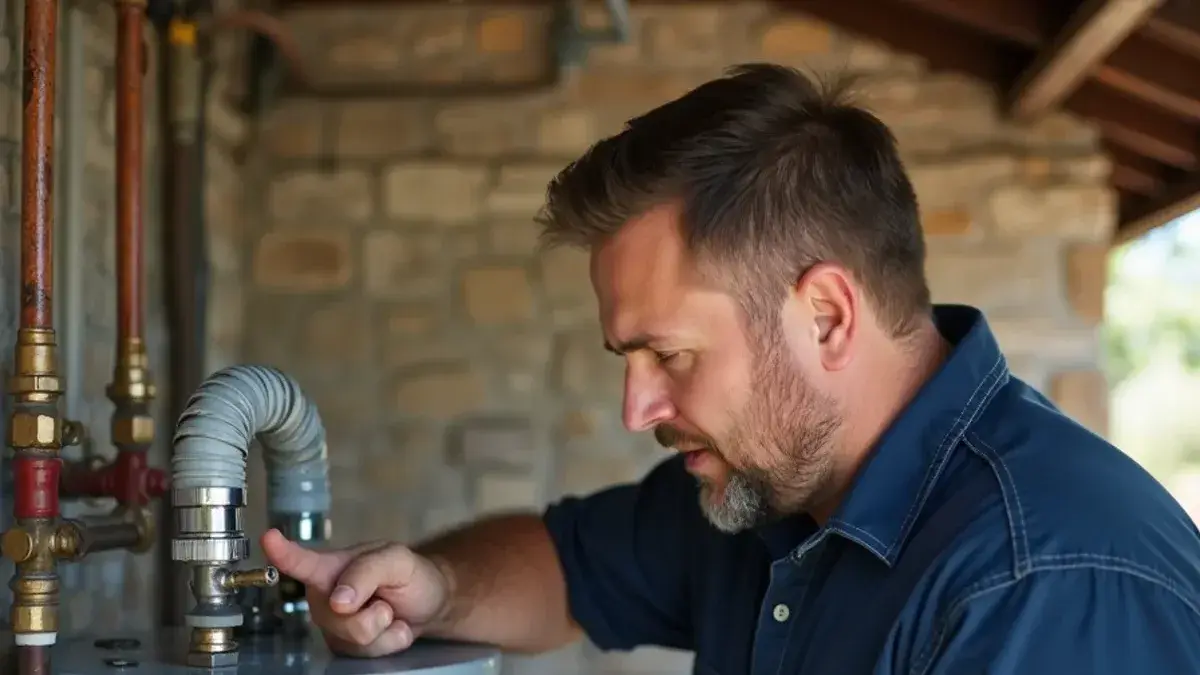
Polybutylene, or PB, is a bendable plastic supply line that comes off a roll, so long runs have few joints. Most of it is a flat medium grey. Blue and black versions exist too, which is why colour alone settles nothing.
The reliable tell is the print on the pipe wall. Polybutylene carries the resin code "PB2110" along its length, often with a size and pressure rating. Wipe the dust off with a damp rag and turn the pipe until the lettering shows.
Fittings are the second clue. Early systems used grey or white acetal plastic inserts squeezed with aluminium crimp bands. Later runs switched to copper or brass inserts with copper crimp rings, roughly an eighth to a quarter inch wide.
Where to look for exposed PB in a slab house
- The hot and cold lines rising out of the top of the water heater
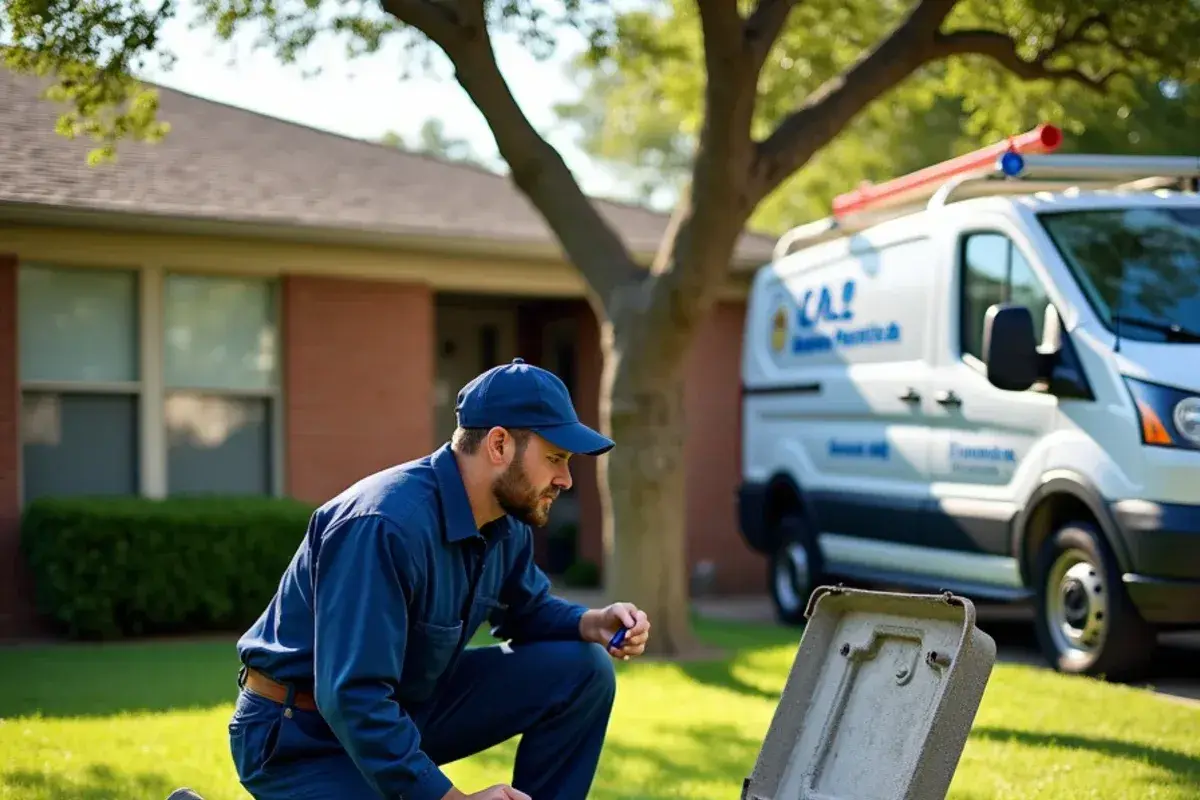
- The meter box and the spot where the supply line enters the house
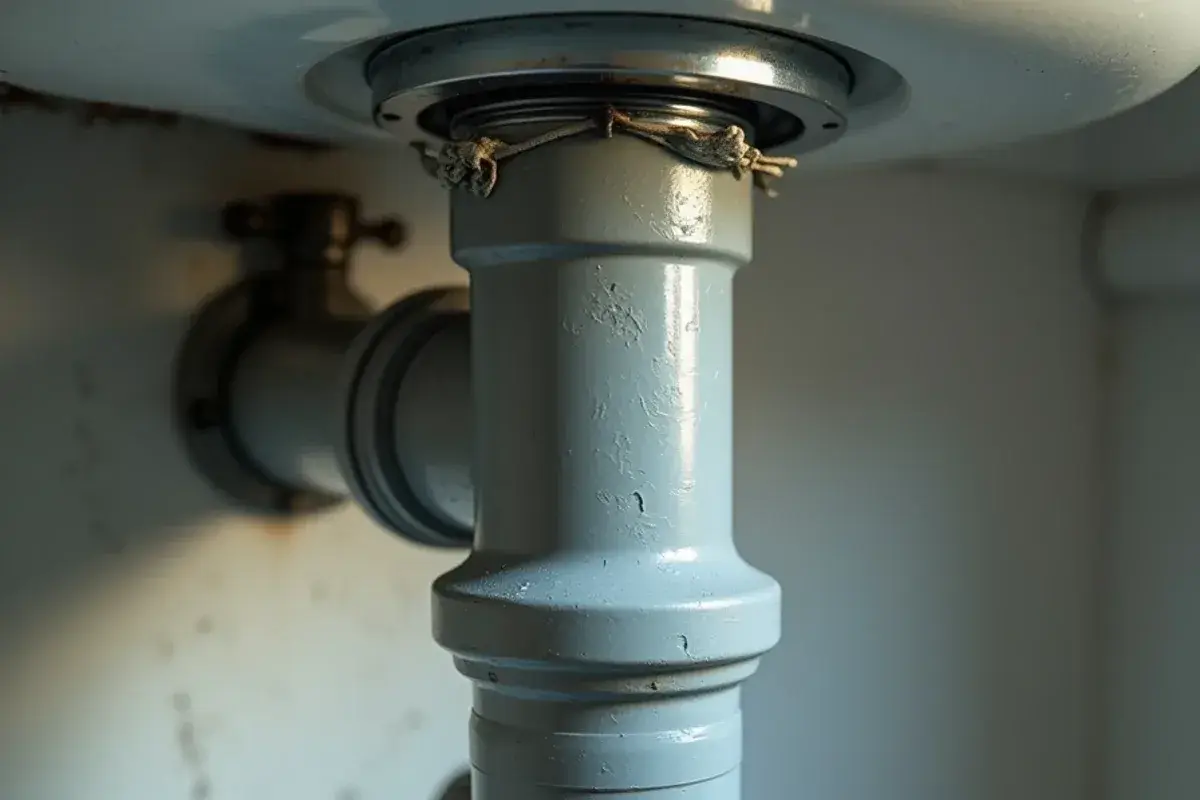
- Stub-outs behind the angle stops under kitchen and bathroom sinks
- The connection behind each toilet and at the washing-machine box
- Attic runs above the garage, since many Central Texas slab homes route supply lines overhead
- Any old repair where a short piece of a different pipe was spliced in
Rule out the look-alikes. Rigid plastic with glued joints is CPVC or PVC, not PB. PEX is also flexible and also uses crimp rings, but it is usually red, blue or creamy white and stamped "PEX".
Local housing
Which Round Rock, Cedar Park and Brushy Creek homes are likely to have PB?
Build year is the best predictor, and much of the I-35 corridor south of us was built in exactly the wrong window.
Polybutylene was installed in homes from roughly 1978 to 1995. That window lines up with a building boom across southern Williamson County, when farmland west of the interstate turned into subdivisions almost street by street.
In Round Rock, the 1970s and 80s neighbourhoods west of I-35, the Round Rock West era, sit in or near that window. Cedar Park grew through the 1980s and 90s in subdivisions such as Buttercup Creek, on Edwards limestone. Brushy Creek is a MUD-run community of 1980s to 2000s slab homes, so its oldest streets fall inside the range too.
| Year the house was plumbed | Likelihood of PB | What to check |
|---|---|---|
| Before 1978 | Low | Copper or galvanized steel is more likely; look for later PB repairs |
| 1978–1985 | High | Acetal plastic fittings with aluminium bands, the most failure-prone type |
| 1986–1995 | High | Copper inserts and copper crimp rings became common from about 1986 |
| After 1995 | Low | PEX or copper; a grey pipe here is more likely PEX, so read the stamp |
Treat the table as a starting point, not a verdict. Builders used up old stock, and remodels added PB to older houses. A home inspection from the purchase may already name the material.
Failure mode
Why does polybutylene fail from the inside out?
The problem is not pressure or age alone. It is the water itself.
Public water systems disinfect with chlorine or chloramine, and both are oxidizers. Industry testing has tied the early failure of polybutylene to accelerated degradation from that chlorine. The polymer chain is exposed to attack, so the inner wall slowly turns brittle and develops fine cracks.
Nothing shows on the outside while this happens. The pipe looks fine until a crack runs through the wall, often near a fitting or a tight bend. Then it lets go as a pinhole spray or a split, usually inside a ceiling or behind a vanity.
The fittings fail on their own schedule. Acetal plastic inserts crack, and over-crimped aluminium bands cut into the pipe. Heat speeds all of it up, which is why PB tied straight into a water heater is a known weak point. By the mid-1980s the trade knew the material had problems, and plumbing codes later dropped it.
Why hard water does not save it
Mineral scale coats some pipes, but it does not protect polybutylene from chlorine. Homes on lake water through BCRUA and homes on MUD supplies both get treated water, so neither escapes the problem.
Expert insight
Spot repairs or a whole-house repipe: an honest comparison
Both are reasonable answers. The right one depends on how many joints you have and where the pipe runs.
A single leak at an accessible fitting can be cut out and bridged with PEX using transition couplings. That stops today’s water. It does nothing for the rest of the system, which saw the same chlorinated water for the same thirty-plus years.
One trade-off we explain on almost every PB call is the attic. Many slab homes in this area run supply lines overhead, so a leak soaks drywall and insulation before anyone notices. That raises the stakes of waiting compared with a pipe under a crawlspace.
A whole-house repipe replaces every PB run, usually with PEX through the attic and walls and a manifold or branch layout. Expect small access cuts in drywall, patched afterward, and a day or two without full water service. Round Rock, Cedar Park and most nearby cities require a permit and inspection for a repipe, and we pull it when the job requires one.
| Question | Spot repair | Whole-house repipe |
|---|---|---|
| Stops the current leak | Yes | Yes |
| Addresses the remaining PB | No | Yes |
| Wall and ceiling access | One small opening | Several small openings, patched |
| Permit and inspection | Usually not | Usually required |
| Best fit | A recent, well-kept system you plan to sell soon | A house you plan to keep, or a second or third leak |
What drives the cost of a repipe is the number of fixtures, the stories, attic access and how much drywall has to open. We quote on site before any work starts, and the quote shows both options when both make sense.

Action plan
Found grey pipe stamped PB2110? Your next five moves
Photograph the stamp and the fittings
Take clear photos of the PB2110 lettering and two or three joints. They help when you describe the system on the phone, and they belong in your house records.
Find and test the main shut-off
Locate the house valve or the curb stop in the meter box and make sure it turns. When PB lets go, closing the water fast limits the damage.
Check the water heater connections
Look for PB tied directly into the heater without metal connectors, and for white or green crust on nearby crimp rings. Both suggest the system needs attention soon.
Watch the meter for a hidden leak
Turn off every fixture and the irrigation, then watch the meter’s leak indicator for fifteen minutes. Movement means water is going somewhere you cannot see, which is a job for leak detection.
Get a repair-or-repipe quote in writing
Ask for both options, the permit status and how access holes will be handled, so you can weigh them side by side.